
From one of the best selling book of Napoleon Hill; Many people make the mistake of assuming that, because Henry Ford had but little "schooling," he is not a man of "education." Those who make this mistake do not know Henry Ford, nor do they understand the real meaning of the word "educate." That word is derived from the Latin word "educo," meaning to educe, to draw out, to DEVELOP FROM WITHIN.
An educated man is not, necessarily, one who has an abundance of general or specialized knowledge. An educated man is one who has so developed the faculties of his mind that he may acquire anything he wants, or its equivalent, without violating the rights of others. Henry Ford comes well within the meaning of this definition. Any man is educated who knows where to get knowledge when he needs it, and how to organize that knowledge into definite plans of action.
In ancient times, India had the Gurukula system of education in which everyone who wished to study went to a teacher's (Guru) house and requested to be taught. If accepted as a student by the guru, he would then stay at the guru's place and help in all activities at home. This not only created a strong tie between the teacher and the student, but also taught the student everything about running a house. The guru taught everything the child wanted to learn, from Sanskrit to the holy scriptures and from Mathematics to Metaphysics. The student stayed as long as he/she wished or until the guru felt that he had taught everything he could teach. All learning was closely linked to nature and to life, and not confined to memorizing some information.
The modern school system was brought to India, including the English language, Originally by Lord Thomas Babington Macaulay in the 1830's. The curriculum was confined to "modern" subjects such as science and mathematics, and subjects like metaphysics and philosophy were considered unnecessary. Teaching was confined to classroom and the link with nature was broken, as also the close relationship between teacher and the student.
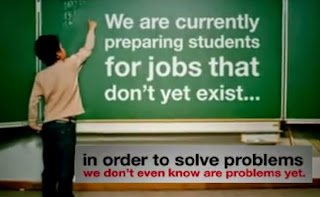

Now the question arise is that "How to acquire knowledge that really matters?" Well to a large extent your major purpose in life, the goal towards which you are working, will help determine what knowledge you need. Knowledge has no value except that which can be gained from its application toward some worthy end.
Successful men, in all calling, never stop acquiring specialized knowledge related to their major purpose, business, or profession. The way of success is the way of continuous pursuit of knowledge. Those who are not successful usually make the mistake of believing that knowledge acquiring period ends when one finishes school. The truth is that schooling does but little more than to put one in the way of learning how to acquire practical knowledge.
Thomas A. Edison had only three months of "schooling" during his entire life. He did not lack education, neither did he die poor.
Henry Ford had less than a sixth grade "schooling" but he has managed to do pretty well by himself, financially.

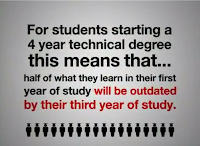
As Greek philosopher and Scientist Aristotle said, "Educating the mind without educating the heart in no education at all.
Thank you very much for your time.
Source:
One of the best selling book of Napoleon Hill, www.gnu.org/education and Internet.
Significant links:
1) Lies are very powerful things and one of the most powerful lies is that "Education can make you Successful"... Don't believe in the lies that other people tell you, just believe in yourself. Great insight from Mr. Dananjaya J Hettiarachchi
https://www.youtube.com/watch?v=kqhUk7eXJLs
2) Sir Ken Robinson makes an entertaining and profoundly moving case for creating an education system that nurtures (rather than undermines) creativity:


Successful men, in all calling, never stop acquiring specialized knowledge related to their major purpose, business, or profession. The way of success is the way of continuous pursuit of knowledge. Those who are not successful usually make the mistake of believing that knowledge acquiring period ends when one finishes school. The truth is that schooling does but little more than to put one in the way of learning how to acquire practical knowledge.
Thomas A. Edison had only three months of "schooling" during his entire life. He did not lack education, neither did he die poor.
Henry Ford had less than a sixth grade "schooling" but he has managed to do pretty well by himself, financially.


As Greek philosopher and Scientist Aristotle said, "Educating the mind without educating the heart in no education at all.
Thank you very much for your time.
Source:
One of the best selling book of Napoleon Hill, www.gnu.org/education and Internet.
Significant links:
1) Lies are very powerful things and one of the most powerful lies is that "Education can make you Successful"... Don't believe in the lies that other people tell you, just believe in yourself. Great insight from Mr. Dananjaya J Hettiarachchi
https://www.youtube.com/watch?v=kqhUk7eXJLs
2) Sir Ken Robinson makes an entertaining and profoundly moving case for creating an education system that nurtures (rather than undermines) creativity:
3) An eye-pad for the blind and much more from this 15 year old: Angad Daryani at TEDxGateway 2013:
https://www.youtube.com/watch?v=wSVYvUHg4UA
4) 4th Grader Rocks Common Core Education By Asking School Board One Question:
http://www.collective-evolution.com/2015/04/21/4th-grader-rocks-common-core-education-by-asking-school-board-one-question/
http://www.collective-evolution.com/2015/04/21/4th-grader-rocks-common-core-education-by-asking-school-board-one-question/
5) Teaching Children How to Think Instead of What to Think:


